Case Study
Q8 Aviation & 360 Jet Fuel Multi-tenant SAF Book & Claim registry platform
Designing a credible platform for tracking, trading, and retiring SAF credits in a market where standards, regulations, and operating models were still evolving — while laying the groundwork for a scalable multi-tenant registry business.
Multi-tenant
designed so the first tenant could be followed by future clients
4
core platform capabilities
RSB-aligned
product definition shaped with certification logic in mind
The Problem
The market opportunity was real, but the rules, workflows, and ownership model were still moving
Q8 Aviation and 360 Jet Fuel wanted to move early in an emerging SAF Book & Claim market. The opportunity was strategic: create a trusted registry and marketplace model before regulation and market structure fully settled.
But that also made the product difficult to define. The system needed to be credible enough for certification alignment, understandable to commercial users, resistant to double counting, and flexible enough to support future clients and changing standards.
Overview
Turning an emerging SAF model into a credible product
In response to increasing regulatory pressure and growing demand for sustainable aviation, Q8 Aviation and 360 Jet Fuel partnered to create a SAF (Sustainable Aviation Fuel) Book & Claim Registry.
The platform enables airlines, corporate buyers, and fuel suppliers to track, trade, and retire SAF credits (BCUs - Book & Claim Units), supporting emissions reduction claims, commercial transactions, and readiness for emerging compliance requirements.
Happy Path Solutions, in collaboration with development partner Kombinat, designed and delivered the platform from the ground up in a rapidly evolving and not yet fully standardized market, while also preparing the product to support multiple future tenants.
The Challenge
Defining a trustworthy product before the market had stabilized
The aviation industry is under increasing pressure to reduce CO2 emissions. Regulators are introducing stricter requirements, while airlines and corporate customers are looking for credible ways to reduce or account for their carbon footprint through SAF adoption targets, reporting obligations, and compliance schemes.
- lack of standardized digital systems
- evolving regulatory and certification frameworks
- unclear data, ownership, and transaction models
- high trust requirements and risk of double counting emissions reductions
Q8 Aviation recognized an opportunity to move early and help shape the category: build and own a SAF registry, enable trading and marketplace functionality, and prepare for upcoming regulatory requirements instead of waiting for the market to mature first.
At the same time, 360 Jet Fuel needed the platform to be adaptable for multiple future clients, introducing multi-tenant product thinking from the start rather than as a later rewrite.
Discovery & Product Framing
Aligning product definition with certification and commercial logic
We began with a structured discovery phase involving stakeholders from Q8 Aviation, 360 Jet Fuel, and RSB (Roundtable on Sustainable Biomaterials) representatives.
Because the domain was still emerging, discovery focused not only on workflows but also on understanding certification standards, defining what a Book & Claim Unit (BCU) represents, mapping ownership and transfer logic, and aligning the product with RSB certification requirements without making the user experience collapse under complexity.
Designing in an Evolving Market
Product decisions had to balance clarity, auditability, and future change
Unlike more stable software projects, this platform was built in a context where industry rules were still forming, requirements evolved continuously, and multiple stakeholders had different commercial and operational needs.
- modeling BCUs as tradable digital assets
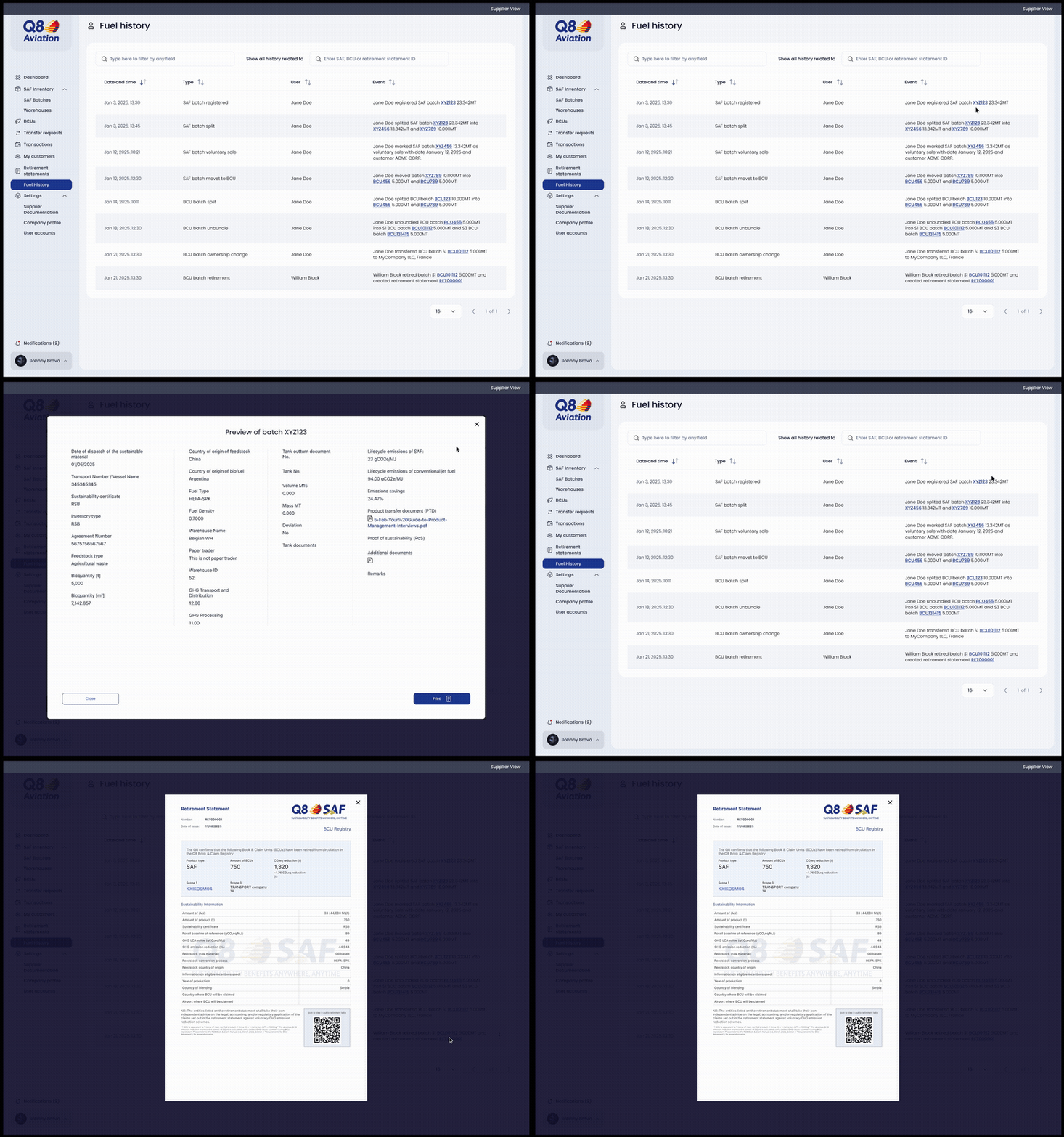
- ensuring traceability, auditability, and retirement integrity
- preventing double counting of environmental claims
- balancing domain correctness with usability for non-expert users
Key decision
We aligned the system with RSB certification standards and worked directly with RSB representatives so the registry could be designed with credible certification alignment in mind from the start.
Product Design
Making abstract environmental assets usable
The design process focused on making complex and abstract concepts usable for real participants in the market. Key UX challenges included representing environmental claims and credits, making ownership and transfer of BCUs understandable, and enabling non-technical users to act with confidence in a system where trust and correctness matter.
We began with low-fidelity wireframes, tested them with users to validate understanding and workflows, and then created a high-fidelity interactive prototype in Figma covering core user flows, marketplace interactions, inventory and transaction management, and reporting and transparency features.
Platform Structure
Four parts working together as one registry platform
SAF Inventory
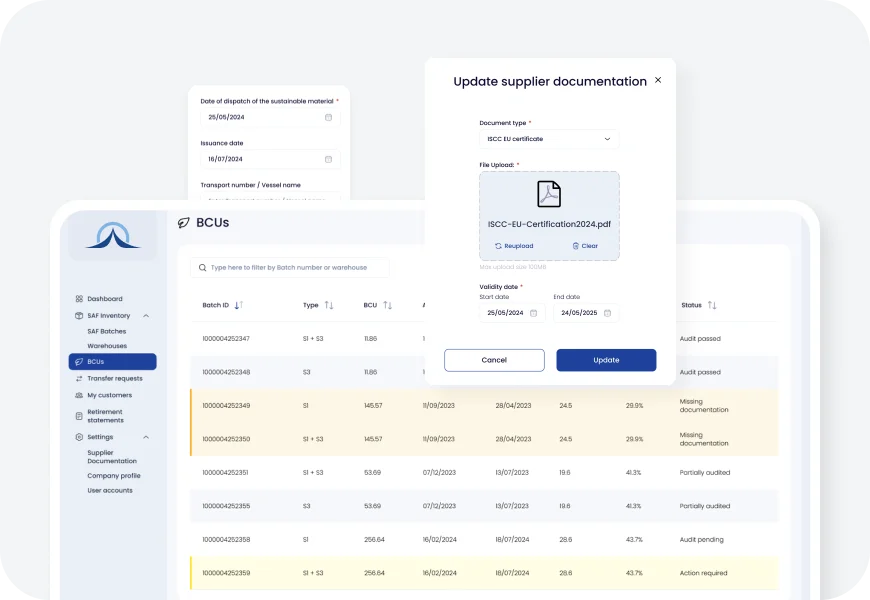
Tracks SAF supply and converts it into Book & Claim Units (BCUs) that can be traded.
BCU Marketplace
Enables listing available BCUs, purchasing credits, and transferring ownership between participants.
BCU Retirement Registry
Provides a public record of retired BCUs to ensure auditability, trust, and prevention of double counting.
Performance Dashboard
Offers insight into SAF inventory, BCU inventory, and sales performance.
Delivery Process
A multi-stakeholder product delivered in tight alignment loops
The platform was developed over approximately six months by a distributed team working across product, design, QA, and engineering.
Happy Path Solutions
Product Management & UX Design
UI Design
Quality Assurance
Kombinat
Software Architecture
Three full-stack engineers
The collaboration model combined daily remote alignment, Kanban-based delivery, weekly stakeholder reviews, continuous work with both Q8 Aviation and 360 Jet Fuel, and direct collaboration with RSB representatives.
An in-person workshop with Q8 Aviation in London ensured alignment across supply, sales, marketing, and legal.

Happy Path team has been a valuable partner in building the Book and Claim platform. I always felt that they truly listened to our needs and found thoughtful ways to address them.

Sonja Whitticase
Marketing manager, Q8 Aviation
Outcome
A live platform built for trust, scale, and regulatory readiness
The SAF Book & Claim Registry platform is now live and undergoing RSB certification.
The system enables SAF credit tracking and trading, supports airlines and corporate buyers, improves readiness for evolving regulations, and provides a credible operational foundation for a SAF marketplace.
The platform was designed as a multi-tenant solution, allowing 360 Jet Fuel to extend similar capabilities to other clients in the future rather than treating the first tenant as a one-off build.
Key Insights
What this project reinforced about designing in emerging markets
Designing without fixed rules requires strong product judgment.
In evolving domains, product decisions must balance correctness, usability, trust, and future adaptability at the same time.
Regulatory alignment is a core product concern.
Building in collaboration with certification bodies increases credibility and reduces the risk of building a system that later fails real-world requirements.
Abstract concepts require careful UX design.
Users must understand ownership, transactions, retirement, and impact clearly for the system to feel trustworthy and usable.
Early positioning creates strategic advantage.
By building ahead of regulation, Q8 Aviation positioned itself to lead in a market that is still taking shape.
Credits
The teams behind the registry platform
Clients
Q8 Aviation
360 Jet Fuel
Product Design & Product Management
Happy Path Solutions
Development Partner
Kombinat
Certification Alignment
RSB (Roundtable on Sustainable Biomaterials)