Case Study
RISE AI interview practice for vocational students, across three countries
A student in vocational education rehearses a real interview in their own trade and their own language, as often as they like, and gets useful feedback straight away. Four organisations in three countries, one platform, and a set of design decisions driven by the fact that most of the students are minors.
240
interview scenarios across 75 occupations, written by teachers who train those trades
3 countries
three data protection regimes, one multi-tenant platform
Open source
released under EUPL 1.2 so any school can run its own copy
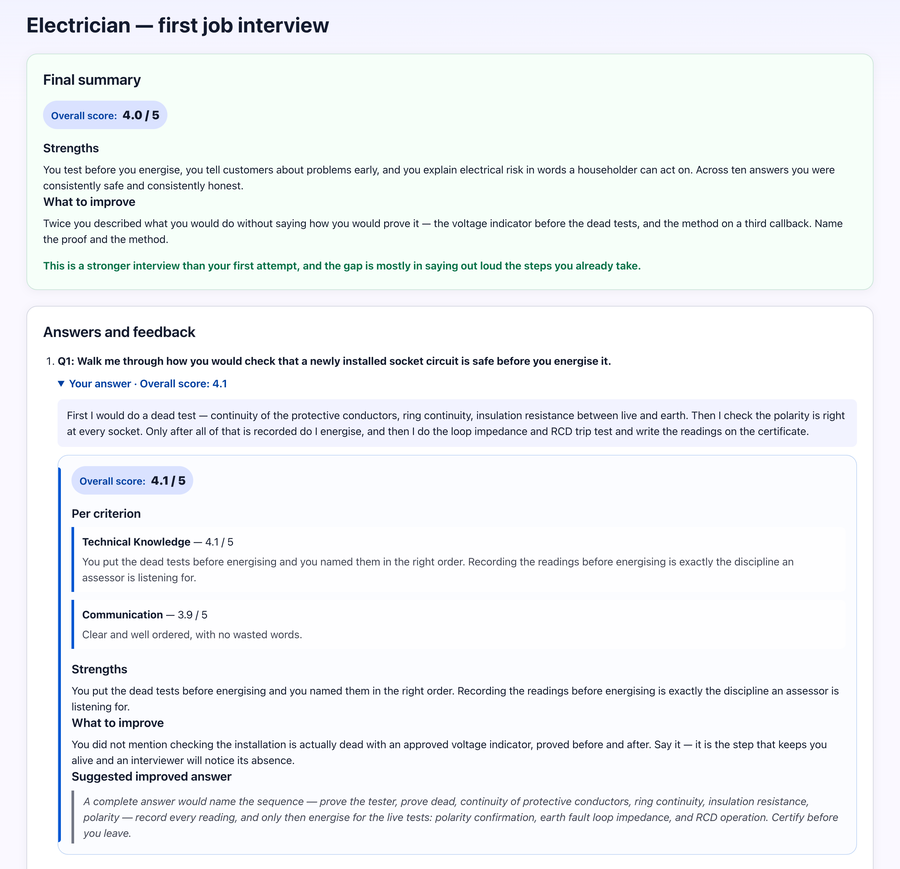
A completed interview, shown with sample content and a sample answer. The pilot runs from October and reports in December. Click to enlarge.
The Problem
Interview practice is limited by the number of people who can give it
Students leaving vocational education are often good at the work and unprepared for the twenty minutes that decide whether they get to do it. Useful practice needs someone who knows the trade, has time, and is willing to be honest about a weak answer. There are never enough of those to go round.
The brief was not to replace that person. It was to give every student somewhere to fail safely, as often as they want, before it matters — and to give the teacher a way to follow along.
Overview
One platform, three schools, four languages
A student picks their trade and the level they are studying at. The platform asks ten questions written by teachers in that field, reads what the student types, and scores it against what a complete answer should contain — then says what was good, what was missing, and what a stronger answer would have looked like.
Each school wrote the interview content for its own trades, in its own language: around five thousand questions and model answers across 75 occupations, from Maçon to Data Analyst. The software's job is narrow on purpose — to ask, to read, and to compare what it reads against what the teacher wrote.
Constraints
Solving for the complex set of requirements
Three schools in three countries each had their own stakeholders and their own regulator. The users are mostly minors, which raises the floor under every decision about what the system may know. The project's inclusion commitments meant designing for students with cognitive and other disabilities rather than for a developer's idea of a user. It had to work on a school desktop with a projector behind it and on a fifteen-year-old's own phone. And it had to run inside a fixed grant with no recurring funding, which put a price on every interview.
Too small an AI model and the comparison against a teacher's rubric becomes flattery; too large and a cohort of a hundred students exhausts the budget before the pilot ends. None of these were solved by choosing well once; each was solved by deciding which of two good things to give up, and writing down why.
The Decision That Shaped Everything
The model marks against a standard it did not write
The obvious build is to let the model generate the questions and decide what a good answer looks like. We did the opposite. A generated rubric for a bricklayer or a data analyst is a plausible guess; a teacher who trains that trade knows. So teachers authored the content, and the model compares a student's answer to what those teachers said a complete answer contains.
- content is imported and versioned, never edited live under a student mid-interview
- every interview records the version of the content it was taken against
- retiring a question withdraws it from new interviews and changes nothing already taken
- each school's content is separate, so nobody inherits another country's trades
This is also what makes the feedback defensible to a teacher. When a student disputes a score, there is a specific, human-written answer to point at.
What Was Built
A full product, not a scoring endpoint
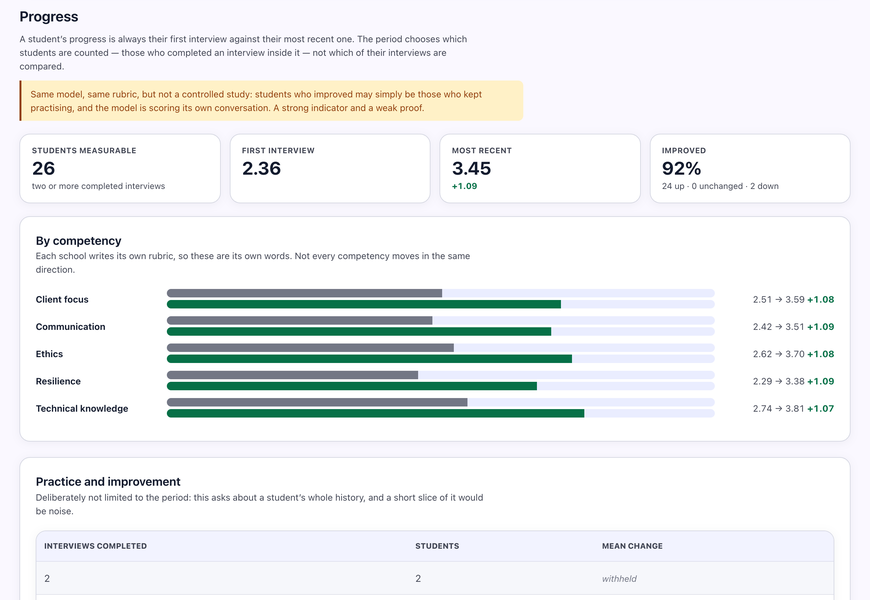
The statistics deserve a note. Schools need to see whether the pilot is working, and aggregate numbers over small classes can identify an individual. Any figure resting on fewer than five students is suppressed rather than shown — the row stays, the number does not, and the screenshot below has a withheld row for exactly that reason.
The same screen carries its own caveat where a reader will see it: students who improved may simply be the ones who kept practising, and the model is scoring its own conversation. A strong indicator and a weak proof. A dashboard that oversells itself to a head teacher is worse than no dashboard.
Designing For Minors
Most of the students are between 15 and 19, which changes what the system is allowed to know
Only What The Exercise Needs
An account is a name, an email address, a role and a language. No date of birth, no national identifier, no address, and no grades — nothing the interview practice does not use.
Administrators Cannot Read Transcripts
Teachers read their own students' answers — that is the coaching. Administrators, at either level, cannot: there is no screen that shows an interview and no endpoint that would return one.
Every Read Is Logged
When staff open a student's record it is recorded, and the record outlives the account it describes — so an erasure cannot quietly erase the evidence that the data was read.
Nothing Inferred From Voice
A student may dictate an answer; the audio is transcribed in transit and discarded. No emotion, stress or confidence is inferred — the AI Act prohibits it in education, and the platform has no field to store it in.
The Half Most Projects Leave Until Last
Three countries meant the legal design and the software design were the same design
The data never leaves the European Union — hosting in Frankfurt, model inference in Paris, nothing stored in Serbia. It is still a restricted transfer under Chapter V of the GDPR, because the Serbian partner's administrators reach the data from a third country, and remote access from a third country is a transfer.
So the partnership needed Standard Contractual Clauses with their annexes, a transfer impact assessment for each exporting school, a sub-processor list, and a student information notice in each language. We wrote all of it alongside the build.
- organisation scoping enforced on the server for every request, never in the interface
- bulk export of another school's data simply not built
- nightly backups encrypted before they leave the server, with the restore rehearsed end to end
- the access log made available to each school on request, so trust is verifiable
The design system, product requirements, architecture and privacy notice were written as the platform was built and published as they stand, so a school considering its own copy can read how it works before installing it — and an auditor can read it without asking us.
Why this matters
For a product used by minors across borders, compliance is not paperwork that follows delivery. Deciding late what an administrator may see means rebuilding what an administrator can do. Writing the security annex while the access control is still being written is far cheaper — and it produces an annex that is true.
Why It Matters
What this project says about building AI products for institutions
AI is often more useful when it is not the author.
The model here never decides what a good answer is. It reads, compares and explains. That narrower job is easier to evaluate, easier to defend to a teacher, and far less likely to be quietly wrong in a trade nobody on the build team has ever practised.
Multi-tenancy is a safeguarding feature before it is a commercial one.
Three schools sharing software do not share a purpose. Each is a separate controller of its own students' data, and the isolation between them is what makes that true in practice rather than only on paper.
An honest security annex is a product document.
Ours lists what is in place, what is not yet in place with dates, and what is deliberately not claimed. A disclosed gap is a risk an institution can accept; a gap discovered later is a different conversation entirely.
Public money should leave something reusable behind.
The platform is open source under EUPL 1.2, with the design system, requirements and architecture published alongside it. A school anywhere can run its own copy with its own trades and language, tied back to nobody.
Credits
A case study in building AI products for institutions that answer to regulators
Project
RISE, Erasmus+ KA210-VET-778D8F70
Product, Architecture, Build
Happy Path Solutions
Delivered For
Tehnička škola Zrenjanin, the partner responsible for the platform
Partnership
Lycée Jacques Le Caron (France, coordinator), Tehnička škola Zrenjanin (Serbia), AEVA (Portugal), Marabunta (Portugal)
Co-funded by the European Union. Views and opinions expressed are however those of the author(s) only and do not necessarily reflect those of the European Union or the European Education and Culture Executive Agency (EACEA). Neither the European Union nor EACEA can be held responsible for them.